



Wireless CarPlay Compatibility: What We Tested Across Car Models
Product Features
-
We tested 33 factory head units across 15 car brands with our Qualcomm CarPlay AI Box. All 33 passed the wireless connection test. See the full compatibility report, how the box connects and what it means for your market.
Product Introduction
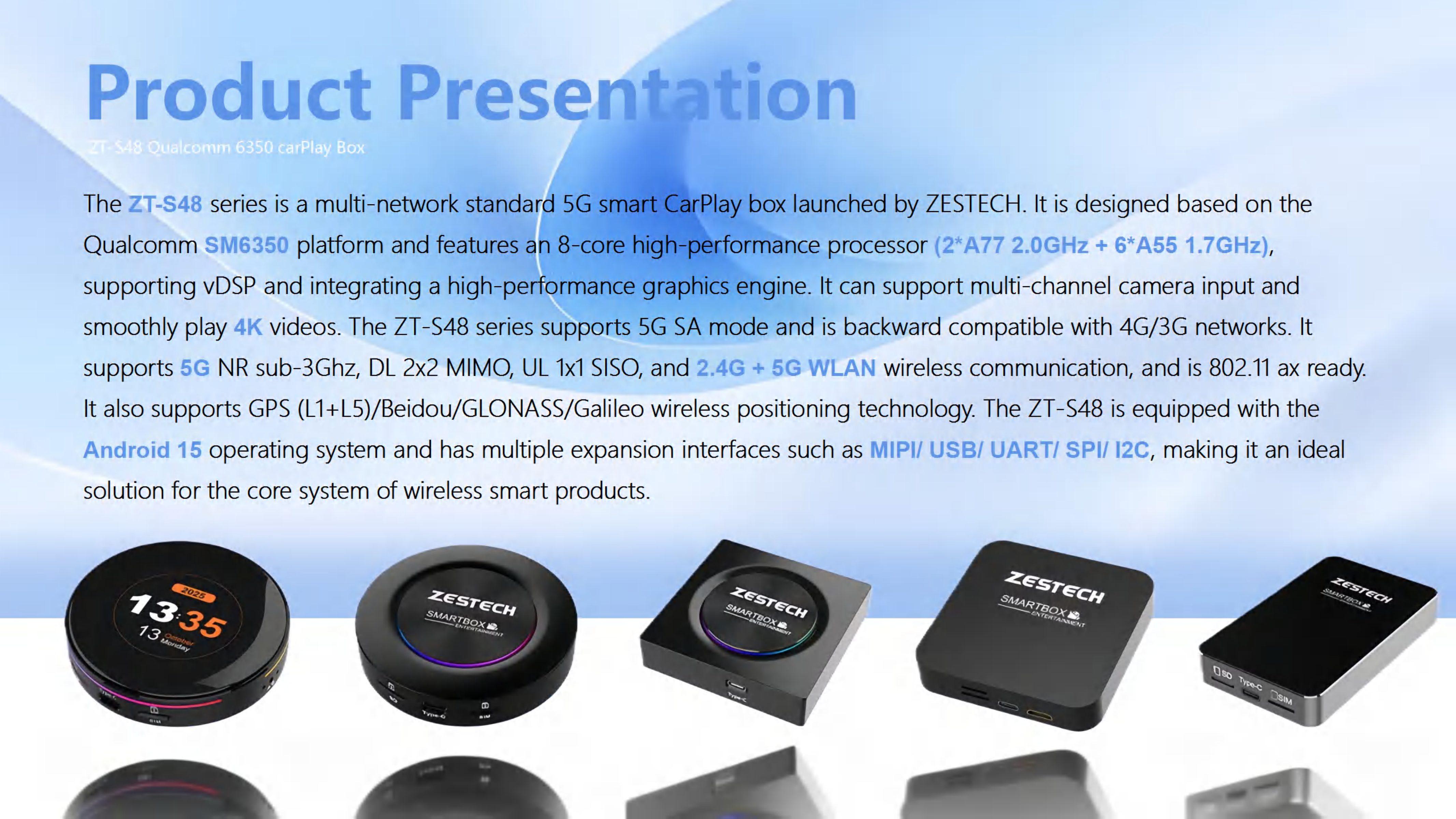
Fig. 1 — The ZESTECH CarPlay AI Box family: Qualcomm-powered boxes that upgrade a factory wired CarPlay system to wireless CarPlay and wireless Android Auto.
Why Compatibility Is the First Question Buyers Ask
An AI box is a small device with a big dependency: the car. Unlike a head unit you install from scratch, a CarPlay AI box has to talk to the original factory system — its screen, its touch controls, its microphone and its USB protocol. If the handshake fails, the product fails, no matter how strong the hardware inside is.
Serious buyers therefore ask three practical questions before comparing RAM or screens:
- ✓Which head units has the factory actually tested? — A real test report beats a “universal fitment” slogan every time.
- ✓What happens on units that are not on the list? — You need to know the boundary conditions, not just the highlights.
- ✓How is compatibility maintained over time? — Cars get firmware updates too; a good supplier keeps testing and updating.
We publish our test data because we want those answers to come from evidence, not adjectives.
The Test: 33 Factory Head Units Across 15 Brands
Our latest round covered 33 factory head units from 15 brand families: BMW and MINI, Toyota, Ford, Volkswagen, Hyundai/Kia, Chery, Mitsubishi, Peugeot, Buick, plus Audi, BYD, Dodge, Honda, Jaguar Land Rover and Great Wall. The units came from different production origins — the USA, Mexico, South Korea, Portugal, the EU, mainland China and Taiwan, China — because the same car model can carry a different head unit depending on where it was built.
Each unit went through a Bluetooth search and connection test: we checked whether the factory system discovers the box, and then whether the wireless CarPlay / Android Auto session actually establishes and runs. Here is the original report, exactly as our engineers recorded it:
Fig. 2 — The original test record: 33 factory head units, BT search status and connection test result, approved by our engineering team.
What “Available” and “Not Available” Mean
Two columns matter in the report. The BT Search & Connection column records whether the head unit’s own Bluetooth broadcasts itself for discovery in that test condition — on 21 units it showed Available, on 11 units Not Available, and on one unit (Chery Tiggo 9, 2560×1440) the field was not applicable. The Test Result column is the one that decides everything: did the box connect and run. On all 33 rows, the result is OK.
The lesson in those “Not Available” rows is the point of this article: the box does not depend on the head unit’s Bluetooth being discoverable. It connects through the car’s wired CarPlay channel first — which is present on every unit in the list — and then bridges the phone to the car wirelessly. Bluetooth is a fallback for setup, not the foundation of the connection.
Results: 33 Out of 33 Head Units Passed
Here is the summary by brand family, condensed from the full report:
One hundred percent connection pass rate — including units where the factory Bluetooth was hidden from discovery, including 12.3-inch and 2560×1440 high-resolution systems, and including head units built on three continents. For a distributor, that is the difference between “we hope it works” and “we know what it does on the cars we ship to”.
How the Box Connects: Why Almost Every Modern Car Qualifies
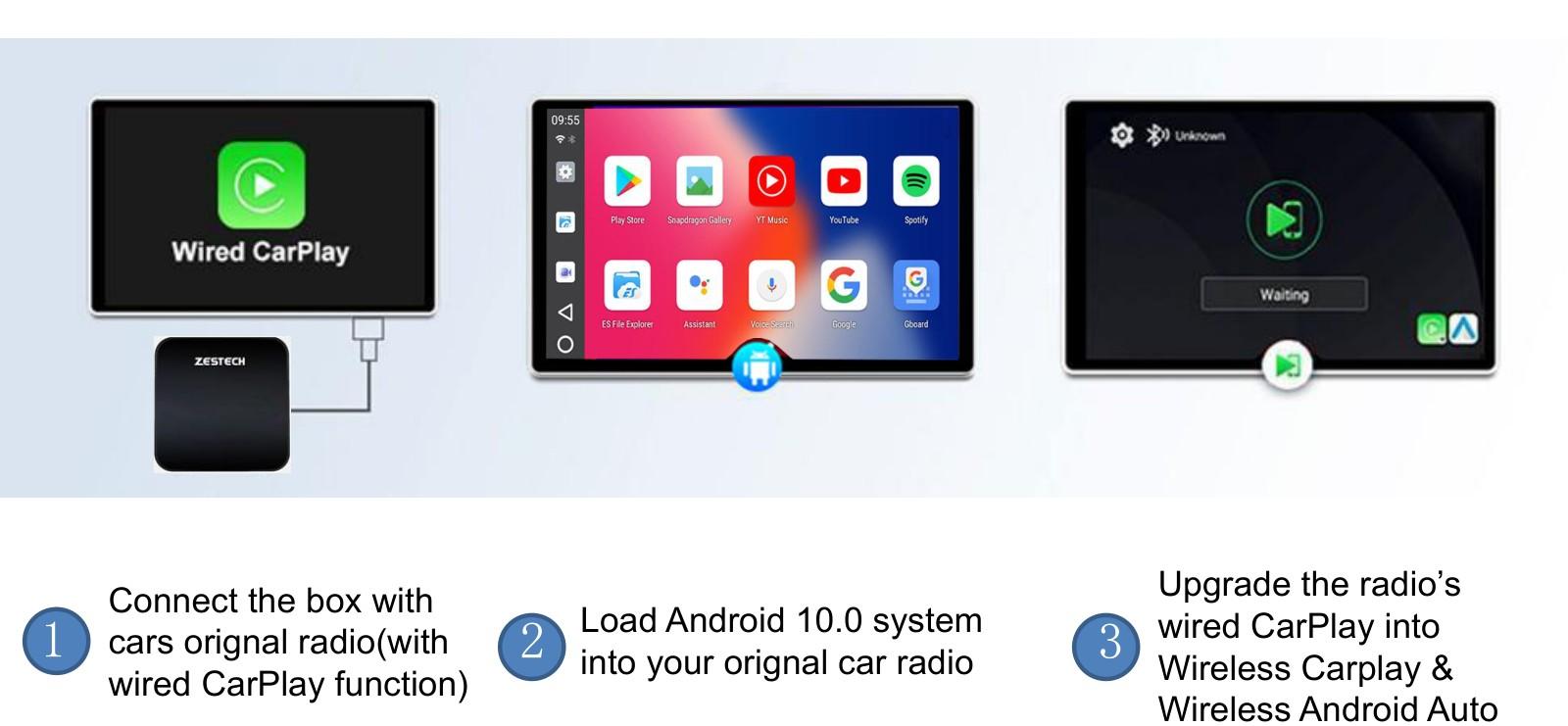
The reason one small box can cover so many cars is architectural. The box does not replace anything in the car — it borrows the car’s existing wired CarPlay pipeline and makes it wireless:
Fig. 3 — Three steps: connect the box to the car’s original radio (with wired CarPlay), the box loads its Android system, and the radio is upgraded to wireless CarPlay and wireless Android Auto.
- ✓The prerequisite is simple — if the car has factory wired CarPlay (or wired Android Auto), the box has the channel it needs. That single requirement covers the vast majority of vehicles sold in the last several years; our product line card puts it at 98% of vehicles with factory wired CarPlay.
- ✓Nothing is modified — plug-and-play via the original USB / Type-C port, without removing or modifying the original wiring, and fully reversible.
- ✓The original experience stays — steering-wheel controls, knobs and the factory screen all keep working; the box simply adds a full Android environment and wireless projection on top.
- ✓One box, two ecosystems — wireless CarPlay for iPhone users and wireless Android Auto for Android users, on the same unit.
Fig. 4 — Our product line card for the wireless CarPlay AI Box: function, compatibility, installation and lead time at a glance.
What This Means for Your Market
Match the test list against your own order book, region by region:
- ✓North America — Ford SYNC-G4 and RADIO AHU, Dodge RAM (R1EXT), Buick and Honda units built in Mexico are all on the pass list. These are volume platforms across the US, Canada and Mexico aftermarket.
- ✓Europe — Peugeot (EU-built), Audi A6L-C8 with MIB3 TOP (Portugal-built), Ford (Portugal-built) and Volkswagen CNS3.0 systems cover the mainstream European premium and volume segments.
- ✓Asia-Pacific and the Middle East — Toyota GRAMIN 12.3", Hyundai Seltos (Korea-built), Chery Tiggo 9 and JAECOO, plus BYD Tang 2024-25 overseas versions, reflect what importers in these regions actually ship.
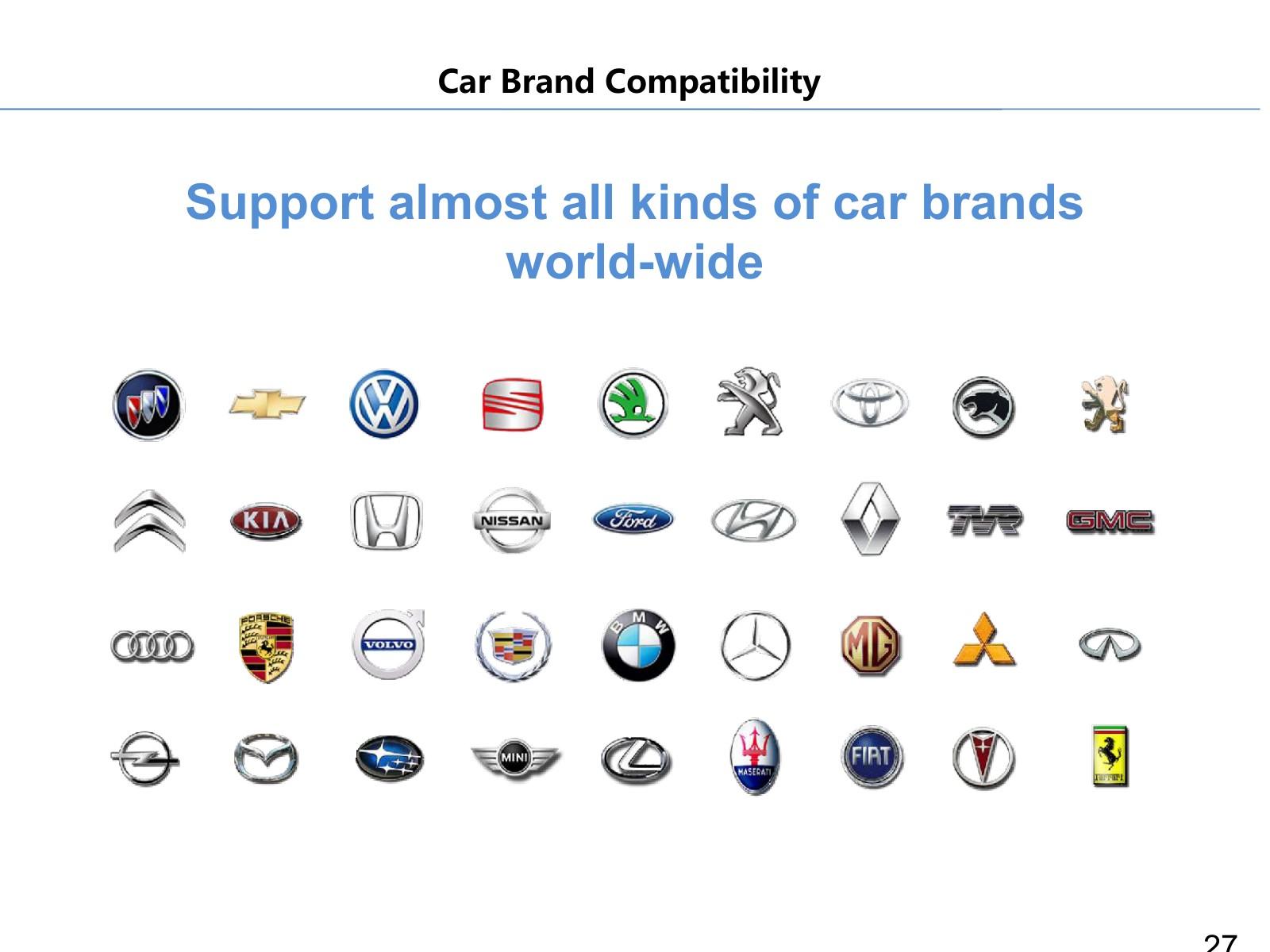
Fig. 5 — Beyond the tested list: the box family supports almost all car brands worldwide — the requirement is factory wired CarPlay or Android Auto.
If a customer’s head unit is not on the list, send us the model and the market — our engineers will evaluate it and add it to the next test round.
Compatibility Is a Living Document — and a Service
The 33-unit report you saw above is one snapshot of an ongoing program. Here is how we keep it current for our partners:
- ✓Customer-requested testing — tell us which head units your market uses; we test them and share the results with you before you commit to a container.
- ✓Firmware maintenance — as new head-unit firmware versions ship from car makers, we re-verify and update the box software accordingly.
- ✓OEM / ODM support — boot logo, UI, packaging and even housing tooling can be customized for your brand, with the same tested platform inside.
- ✓Certified hardware — our products carry CE, FCC, E-Mark, RoHS and CCC approvals, and our quality system is certified to IATF 16949 and ISO 9001.
Why Choose ZESTECH
SHENZHEN ZEST TECHNOLOGY CO., LTD has focused on automotive electronics since 2013: a national high-tech enterprise with 125 authorized patents, 160 software copyrights and more than 50 R&D engineers, manufacturing in our own 50,000 m² production base with 7 production lines and an annual capacity of 3 million units. Qualcomm, MediaTek, Intel, Samsung, NXP, ST, Rockchip and UIS are our platform partners — the same silicon ecosystem that powers the boxes in this test report.
Fig. 6 — Our 50,000 m² production base: in-house manufacturing is what makes systematic compatibility testing possible.
Let’s Talk About Your Project
Tell us which car models and head units dominate your market — we will share the matching compatibility results, recommend the right box configuration, and quote OEM options. Sample orders are welcome before container commitment.
Email: info@szzest.com
WhatsApp: +86 135 9032 6885
Tel: +86 755 2369 9550 | Web: www.szzest.com
Send Inquiry →Factory: Building A, Huada Industrial Park, Fuqiao Third Industrial Zone, Fuhai Street, Bao’an District, Shenzhen, China
#CarPlayBox #WirelessCarPlay #AndroidAuto #AIBOX #CarPlayAIBox #Qualcomm #CarMultimedia #AutoAccessories #CarElectronics #Aftermarket #OEMODM #HeadUnit #CarStereoUpgrade #Distributor #ZESTECH

Tel: +86 755 2369 9550
Email: info@szzest.com
Add:
Building A, Huada Industrial Park, Fuqiao Third Industrial Zone,
Fuhai Street, Bao 'an District, Shenzhen, Guangdong


Design:jiasuweb